VPS-MICRO Technology
VPS-MICRO® computational software predicts the life of manufactured parts by simulating the behavior of materials from which they are made.
VPS-MICRO is built on three inescapable truths:
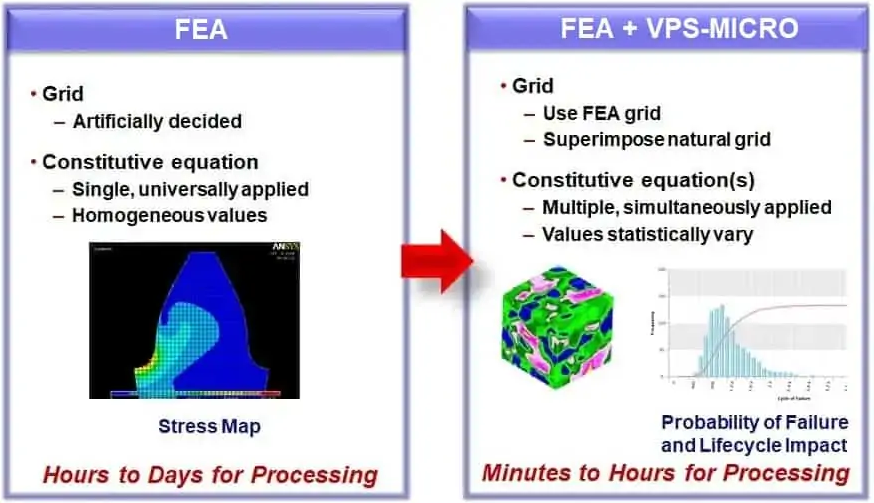
Using these ideas as a foundation, VEXTEC developed VPS-MICRO® to be a computational software that accurately accounts for a material’s reaction to the stress imparted upon it, its variability and all its various damage mechanisms, its geometry, and the conditions of its usage over time. The result is a time- and condition-based product simulation in 3 dimensions, that accurately and efficiently reflects the real world physics of how, when and why damage occurs.
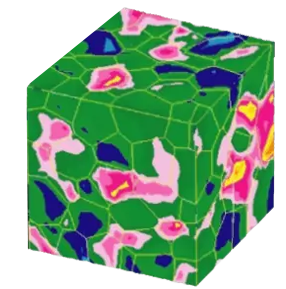
A manufactured component is really an assembly of millions of individual material grains of minute size that have been formed together to make up its microstructure. Any manufacturing process (forging, casting, welding, and especially additive manufacturing – AM) creates a variety of material microstructure complexities within each product coming off the assembly line. In the field, as products are flown, driven, pushed, pulled, heated, cooled, or exercised in any combination of ways, stress is imparted on the product and absorbed throughout its material microstructure.
Computational software like Finite Element Analysis (FEA) predicts how this energy is distributed in unequal patterns. However, it’s well known that not all product failures occur at the highest stress areas, nor do they originate at the global component level where FEA is applied. Failure is actually a localized process that occurs deep within the material microstructure itself.
VPS-MICRO
Our software’s algorithms predict the probability of degradation for every simulated grain, and then component-level durability is derived by aggregating the results of those millions of simulations.
In addition to simulating every grain within the microstructure, VPS-MICRO also simulates the effects of voids, inclusions, defects, and grain boundaries (all the various features that are derived from real world processing) to determine how they will react to the stress energy imparted upon them. A single fleet durability prediction can consist of hundreds of billions of individual simulations processed together. To forecast the durability of component fleets being operated in complex in-service usage scenarios, our desktop/laptop software efficiently conducts these hundreds of billions of simulations in processing times measured in hours rather than months or years.